Dr. Podbielski's micronutrients, 1980s (with drawing)

15 April 2021 13:42

Author unknown (newspaper clipping missing)

Original article from the newspaper at the very bottom. 

Dr. Podbielski's micronutrients

Downtown Warsaw, early morning. Around the Poniatowski Bridge more than usual parked cars. The license plates show that people have come here from the remotest corners of the country. (Dr. Podbielski also received treatment in Warsaw, he lived in Miedzyrzecz and had his office there).

Passengers disembarking from the bus, which stopped vis a vis the house with number 14, quickly disappear into the gate of the old, pre-war building, to which a modern segment has recently been added that fits the whole like the proverbial fist to the eye.

In a large concrete courtyard, surrounded on all sides by the walls of the building, a snaky queue of people waits in a snaking line.

-Today will come a long wait," worries an elderly woman looking for the end of a giant tail.
-I think it will go down by the evening.
-Eee, there's a lot on repeat," consoles another, "but with three or four hours we'll stop for sure.

Nearly 7,000 people are waiting to see the "great quack"! The queue takes up three-fourths of the courtyard and the stairwell up to the fourth floor. People stand punitively, without pushing, shouting or arguing - perhaps because only the order applies here, and not privileges related to disability, pregnancy, etc. All that is known is that there is enough medicine for everyone, as well as everyone will be admitted despite the official office hours of 9 to 11 am.

-Ech, if our socialized health service worked like this," sighs a young girl with glasses, who has already visited many clinics in search of rescue for her hair, which is falling out in handfuls.

I take my place at the end of the line. I light a cigarette.
-Don't do it! - shouts the woman standing in front of me.
- No smoking allowed here! Cigarette is 57 carcinogens. The doctor does not allow smoking, and if he sees from the window, he will not give medicine.
So I extinguish a freshly sipped "Zephyr" and then I hear the doctor chase away not only all smokers by calling them "bastards" and "stinkers," but also dislikes drinkers and uses a few other blunt terms towards them.

I learn from regular patients waiting in line that Dr. Tadeusz Podbielski is a... veterinarian by profession. He is now over 80 years old; ten years ago he earned his doctorate at the Faculty of Veterinary Medicine of the VRS in Wroclaw; that the drugs named after his initials, TP-1 and TP-2, are micronutrients that are a variant of a biogenic stimulator that increases the body's immune defenses; that TP-1 contains only cobalt chloride, while TP-2 contains salts of many other heavy metals such as iron, zinc, copper, manganese, etc., in addition to cobalt chloride. I hear that in 1977 the doctor received an official patent for his preparations, and since then has been unsuccessfully negotiating with "Polfa" about taking up production of the "elements" on a wider scale. [...]

A woman wipes her hand with tears at the thought of what will happen to all those people who have been treated for years at the doctor's, if, God forbid, the doctor dies, and no one else in Poland can or wants to produce the priceless concoction that has been saving the lives of many sick people for nearly 30 years.

-And it all started with a dog," says a man who has been treated at Podbielski for 5 years for liver cancer.
-Not from the dog, but from the cow," straightens a woman with bronchial asthma drinking "elements" without much effect for three and a half years, "The dog was later. First, the cows in Miedzyrzecz, where the doctor lives constantly to this day, stopped giving milk and died. The doctor examined them and started giving TP-1, because there was no cobalt in the hay they ate.
-Yes, you are right," the man admits. - The cows healed themselves. Later there was a dog. A bitch with breast cancer, that is, nipples. They brought her to the doctor to be put to sleep, and he cured the doggie for three months. The cancer disappeared, and the dog continued to go hunting.
-Then the doctor cured an anemic child, a woman with cancer on her uterus, and people started coming to him from all over Poland, reports an old woman sitting on a folding chair brought from home, whom the doctor cured of "indigestion" within a year.

Dr. Podbielski's well-informed old patients are constantly being joined by new ones, lured by the fame of the "miracle witch doctor" circulating for many years in and around Warsaw. When official medicine is unable to help (not only in the case of cancer!) people seek rescue or relief from suffering by any means available. And they have an undeniable right to do so, after all. Hence, in the queue in front of the house there are not only old people, but also middle-aged people, young people and mothers with small children. Everyone hopes that perhaps they too will be healed by colorful concoctions prepared by an "initiated alchemist" with a doctorate.

TP-1 and TP-2 often turn out to be the last chance.

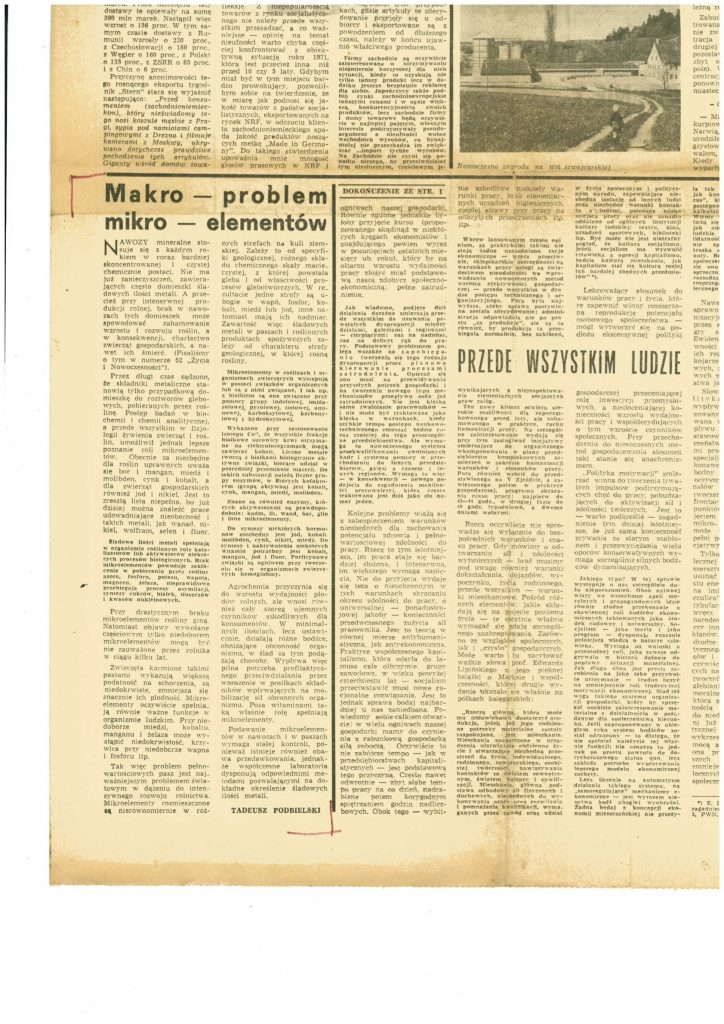
Macro-problem of micro-elements, 1971.

12 April 2021 12:52

LIFE AND MODERNITY
THE LIFE OF WARSAW

8 – 07-1971

Original article at the bottom.

Macro - the problem of micro - elements

Mineral fertilizers are used every year in an increasingly concentrated and chemically pure form. There are no longer impurities, often containing admixtures of trace metals. And yet, with intensive agricultural production, the lack of these admixtures in fertilizers can cause stunted growth and development of plants, and as a consequence: the charring of livestock and even their death (We wrote about this in issue 52 of "Life and Modernity").

For a long time, it was thought that metallic constituents were just an incidental admixture to soil solutions, taken up by the plant. However, advances in research in bio chemistry and analytical chemistry, and especially in the physiology of animal and plant nutrition, have made it possible to better understand the role of micronutrients. Today, boron and manganese, copper and molybdenum, zinc and cobalt are considered essential for crop plants, while iodine and nickel are also considered essential for livestock. This is, by the way, an incomplete list, because already today one can find works proving the absence and such metals as vanadium, nickel, tungsten, selenium and fluorine.

Trace amounts of metals act as catalysts or activators of certain biological processes in the plant body. Lack of micronutrients causes disruptions in the uptake of nitrogen, phosphorus, potassium, calcium, magnesium, iron by the plant, assimilation processes, synthesis of sugars proteins fats and nucleic acids go wrong.

With a drastic lack of micronutrients, plants die. In contrast, symptoms caused by only a partial micronutrient deficiency may not be noticed by the farmer for several years.
Animals fed such feeds show greater susceptibility to disease, are anemic, and their fertility is greatly reduced. Micro elements, of course, have equally important functions in the human body. When copper, cobalt. manganese and iron are not selected, anemia can occur, crohn's disease with calcium and phosphorus deficiency, etc.

Thus, the problem of full-value feed is the most important global problem in the pursuit of intensive agricultural development. Micronutrients are distributed evenly in different zones on the globe. This depends on geological peculiarities, the different chemical composition of the bedrock from which the soil was formed and the characteristics of soil-forming processes. As a result, some zones are deficient in calcium, phosphorus, cobalt, copper or iodine, while others have an excess of them. Thus, the content of trace metals in forage and plant food products depends on the nature of the geological zone in which the plants grow.

Micronutrients in plants and animal organisms occur in the form of organic compounds or are bound to them. Thus, for example, they are bound to proteins with indole, imidazole, pyrolyl, thiol, ami new, carboxyl, carbonyl hydroxyl groups.

It has been shown using the Co60 isotope that all protein fractions of blood serum obtained on electrophoregrams can contain cobalt. Numerous metals form biologically active compounds with proteins that are involved in indirect metabolism.

Such substances include numerous groups of enzymes in which the cofactor (active group) is cobalt, zinc, manganese, copper:, molybdenum. Also known are enzymes whose activators are likely to be cadmium, lithium, vanadium, barium, aluminum and other trace elements.

For the synthesis of some hormones, iodine, cobalt molybdenum, zinc, nickel, copper are required. Cobalt, manganese, iodine and fluorine are required for the synthesis and activation of some vitamins. Porphyrin compounds are a link in the formation of hemoglobin in animal organisms.

Agrochemicals contribute to increased crop yields, but they also bring a whole range of negative factors harmful to consumers. In minimal amounts, but constantly, various stimuli act, lowering the body's defenses, followed by diseases. Therefore, there is an urgent need for prophylactic counteraction by bringing ingredients in meals that affect the mobilization of the body's defensive forces. In addition to vitamins, micronutrients play this role:

The administration of micronutrients in fertilizers and feeds requires constant control, as there are also both wa overdose, but that modern laboratories have the appropriate methods to accurately determine trace amounts of metals.

TADEUSZ PODBIELSKI

podbielski-mikroelementy-tp2-artykul-makro-problem-mikro-elementow

Veterinary Life on T. Podbielski, 1966.

12 April 2021 12:52

VETERINARY LIFE
04-1966

Tadeusz Podbielski

Col. Tadeusz Podbielski He was born on March 26, 1903 in Lomza. There he graduated from high school in 1926 and then entered the Faculty of Veterinary Medicine at Warsaw University. He received his diploma as a veterinary surgeon. He received it in 1931. Immediately after graduation, he was called up to the army to the one-year Cavalry Officer Cadet School in Grudziądz.

The professional work begins Kol. Podbielski As a district doctor in Piatnica near Lomza, from where he moves to Konin in 1934. He works here until the outbreak of war. While performing his professional duties Kol. Podbielski makes himself known to the local population not only as a good professional, but also as a social activist. He tries not only to treat animals, but also to heal human relations. From this second side of his activity, he is remembered by the residents of Piatnica, especially from Kolno and the surrounding area.

This is because the then local dairy cooperative in Kolno owes its development to his social commitment and energy. Holding the position of chairman of the Supervisory Board, he gathers around it assets, whose work in a short time makes the cooperative grow from bankrupt to one of the largest of its kind in the Bialystok province. Gradually expanding its business activities into the purchase of other crops, the cooperative seriously contributes to the economic revival of the region and the improvement of the livelihood of local farmers.

The outbreak of war interrupts Kol. Podbielski In Kolno. Recalled to the army, he serves as head of the divisional hospital in the 18th infantry division of the "Narew" group. After being taken prisoner by the Germans, he stays in a POW camp in Deblin, from where he manages to get out with difficulty, thanks to the efforts of his wife. Podbielskis They then settle in the Radom district, first in Glowaczewo and then in the village of Rogozek. Kol. Podbielski works as a veterinarian. He also services estates created by the Nazis such as Lipie.

At the time, the work of a veterinarian offers great opportunities to provide assistance in saving people and property. Podbielski takes advantage of these opportunities and cooperates with secret military organizations operating in the area.

After the war ended, the Podbielskis moved to the Western Territories to Miedzyrzecz Wielkopolski, where Kol. Podbielski assumes the position of district veterinarian and has held this position to the present day.

As he once did in Kolno, Kol. Podbielski is known not only for his professional activities, but also for his social activities in his district. He is interested in literally all matters of the Miedzyrzecka Land.

For his merits in professional and social work, Col. Tadeusz He was awarded the badge "For merits in the development of Zielona Gora Province" and awarded the Golden Cross of Merit.

Writing about Kol. Podbielski one cannot fail to mention also his wife Sophia, who alongside him actively participated in underground activities during the occupation period, as well as today in Miedzyrzecz sacrificially working in the community. She is a councilor of the MRN, chairwoman of the Social Welfare Committee, president of the Circle of the Society for the Care of Animals. For her work, like her husband, she received a badge "For merits in the development of Zielona Gora Province."

The Mystery of Dr. P., 1982.

12 April 2021 12:52

Gorzow Land
27 08.1982
pos32

Original article added at the bottom.

The mystery of Dr. P.

By what right?
The sensation was carried around the world
They had to save themselves by running away
Thank you sincerely for your help," writes a doctor from Lodz, Poland
Before the court
Promises of a tinkerer
Rehearsals in a small hospital
If Dr. P. were an institution ...

The failure of the first attempt, made in 1955, to take the TP drug from the stage of his own private experiments and experiments into the world of official medicine, did not faze Dr. Podbielski. You could say: he didn't have the time or conditions to break down. What prevented him from doing so were the increasing number of patients coming in for the cure and, above all, the results he achieved. These results constantly caused the fame to grow, and legends began to circulate about Podbielski. There was a lot of understandable sensationalism in these legends, and probably a lot of fabrication on occasion as well. All this, however, stemmed from the natural need for a person in a critical health situation to believe in the effectiveness of a therapy or drug . Dr. Podbielski's TP gave such faith, strengthened it evident cases of cancer cures that official medicine could not handle.

Each such case surprised doctors and must have created new myths, new legends, and one cannot be surprised. So some looked at Podbielski with admiration at the time, and many with a feeling of envy. " How so," said the latter. - A veterinarian, and he takes to treating people? By what right? " This envy in some heads was fueled, as it were, unintentionally, by the numerous press publications about Dr. Podbielski that began to appear in the second half of the 1950s. As was the case with me, even then, twenty-odd years ago, journalists coming to see Podbielski were distrustful, full of skepticism. In doing so, many set in motion the machinery of private investigation to describe the case as objectively and critically as possible. One of the first journalists, editor G., who came to Miedzyrzecz, specifically to Podbielski's veterinarian in early 1956 from Poznan, having gathered various opinions about Podbielski, still went to the local party secretary as a precaution, to ask him too what he thought of the man and the fact that he treated people in addition to animals. - This doctor, Comrade Secretary, instead of treating cattle, he still treats people? And what do you guys think about that? - What do I say to that? And you know what? - replies the secretary. - To tell you the truth, he also helped me. I was treated in Poznan and nothing, it continued to be bad. So Podbielski gave me his medicine. And look, Comrade Editor, I am healthy and working.

Was there a need for a better opinion? So at the end of March 1956, three articles by Jan G. appeared in Poznan's Głos Wielkopolski. About Podbielski and his drug. After a year more followed. Also in "Gazeta Zielonogórska". The journalist wrote : "I drove to Miedzyrzecz without conviction. It looked like a boring conversation. And meanwhile..." The sensation carried around the world. In one magazine for the foreign Polish community, a journalist wrote: "Thousands of people owed him their lives and health. Letters are pouring in to Dr. Podbielski from America, Canada... In 1969, "Panorama of the North" devotes an entire page to Podbielski. One of the first journalists to popularize the person and medicine of Dr. Podbielski was Henryk Ankiewicz from Zielona Gora. In the summer of 1966, his report appeared in the "Gazeta Zielonogórska" with the telling title: "Who are you, Dr. P.?". Articles about Podbielski appeared in the Polish press in the United States and in the Soviet press. The author of the report in the 16th issue of Directions in 1978 writes: "I was provoked to write this article by pure coincidence. One of my acquaintances is suffering from a serious disease (lung cancer - note BS). A decision was made at the hospital: surgery. He did not agree. He left the hospital on his own demands. For several weeks he has been under the care of Tadeusz Podbielski. The agonizing disease symptoms have ceased, he has gained weight... He has authorized me to describe this story..." Two years ago, an extensive report on Dr. Podbielski and the history of his TP drug appeared in the popular "Reporter's Express" (Krzysztof W. Kasprzyk: "Podbielski's Micronutrients").

Eleven years ago, Tadeusz Podbielski himself wrote about these problems in an article in Life and Modernity entitled "The Macro Problem of Micronutrients." These, and dozens of other publications, meant that the number of people lining up for the drug kept growing. New ones were arriving. After the first newspaper articles, such as this one, "Who are you Dr. P.?" Mr. and Mrs. Podbielski experienced a veritable earthquake in Miedzyrzecz. People entered the apartment through doors and windows. In the end, the Podbielskis had to rejet to Warsaw to wait out the storm there. This is the case after almost every publication. I sympathize with Dr. Podbielski and his brave wife, because after the first episodes of my report appeared, they probably don't have peace in their home either. I tried to call there, but judging from the fact that no one answered the phone I assume that this time too they both fled to Warsaw to wait out the assault on their home. Nothing I can do about it, unfortunately. I know that none of my appeals will help. This, moreover, is the price Dr. Podbielski has been paying for many years for his invention. But its annoyance is mitigated by this abundant evidence that the drug is simply helpful in many cases. Specialists, medical doctors, such as Dr. Wlodzimierz G. from Lodz, Poland, also write about this in their letters to Dr. Podbielski. His mother-in-law was diagnosed with lung cancer at the age of 71: "I would like to inform you," he writes in a letter to Podbielski, "that the medicines recommended by you have proven to be very effective. In our mother ... at the beginning of 62, radiologically there were lesions in the left lung with suspected cancer. Due to old age, bronchoscopy was not performed. After a year of taking the drug, there was a significant improvement in the sense of lowering the ESR, improving the patient's appetite and mood. In May 64, on a lung radiograph, the changes from the 62 period were not found. My sincere thanks for the help shown to my mother..."

The growing popularity of Dr. Podbielski's drug with each passing year, in which, as I mentioned, a significant role was played by numerous press publications, was the proverbial beam in the eye of those who envied him. As in any profession, such envy exists and makes itself known in this world as well. It manifested itself in various ways. There were those. Who said: what right does this veterinarian without the authority to treat people have so many patients? There were also those who wrote denunciations where necessary and heated up the judicial authorities to finally deal with the "Podbielski affair" and punish the vet. Well, and in part they got their way. In 1966, more than thousands of letters from patients from Poland and abroad and a sizable notebook with observations were seized from Tadeusz Podbielski. It took two years of various interrogations of people in Poznan. Efforts were made to catch at least one case of harmful effects of the TP drug. None was found. The case finally went to court. There were three hearings. Podbielski appeared for them without a lawyer. He defended himself. He was defended by the people he helped. Are there powers to treat people? - Podbielski is asked by the judge. There aren't," the man replies, "I'm just a veterinarian. But, asks the court, what am I supposed to do when even doctors, professors refer people to me? He gave the court a list with the names of professors of medicine, but also a list of institutions that he had been knocking for them to take care of his medicine, no one seriously took care of him. This was certainly not an easy case for the court. Podbielski was acquitted. The Provincial Court in Zielona Gora, in justifying its February 1968 verdict, stated, among other things: "In discontinuing the proceedings, the Court of First Instance was guided, among other things, by the fact that the defendant acted disinterestedly, not demanding payment for the medicines he used, that he was guided by humanitarian motives, believing that the medicines he used brought people relief, for which he had evidence in the form of numerous letters of thanks from the sick.

The prosecutor's review incorrectly attaches great importance to the study on file..., prepared by Prof. Dr. Med. Jasinski, which is unable to categorically pronounce that the trace elements used by the accused, in the form of cobalt and other trace elements, have a detrimental effect on human health.

Such a statement cannot be based on a team opinion..., for it is clear from the annotation under this opinion that the issue of the use of micronutrients and their effects on tumor growth is open, and that there is a basis for a scientific examination of veterinarian Podbielski's hypotheses.
If, in this situation, the micronutrients applied to the patients brought them relief (vide testimonies of witnesses) and the numerous letters of thanks and even prescriptions issued by doctors to the patients for the specifics produced by the accused Podbielski, and if the treatment of these patients was supported by experiments used on animals, it is difficult to assume that in the actions of the accused fell such a degree of social danger as to require the victimization of the accused ....
The property of a sick person, as is well known, and in addition to cancer, is to defend his health by whatever means are available to him ..."

This court case, which ended in acquittal, did not interrupt the doctor's activities for a moment. People continue to come, he dispenses his medicine to them, they leave, write letters, and report their condition. Many of these people were under the control of the Oncology Institute in Gliwice. Many of them were simply forced by Dr. Podbielski to have regular medical checks. Drinking the TP solution was one thing, and constant contact with a specialized facility was an obligation. In this way, the doctor forced several patients to revisit the Institute in Gliwice, from which they had at one time been discharged. There, in turn, since these were very difficult cases, they were surprised that these women were still alive. In turn, they told of the fact that they were simply drinking Podbielski's drug and were therefore alive. The Institute took an interest in Podbielski. In 1957, he received a letter signed by the director of the Institute, Dr. J. S.: "I have learned that you are treating some of our cancer patients. In this connection, I would be grateful to you for communicating with me on the application of treatment methods." He went. He took with him the results of his tests and observations.

- Doctor," he was answered. - Please do not convince us. We are already convinced by the example of our former patients. It was an encouraging and promising visit. Dr. Podbielski hoped that this time the case for his drug would finally move from a dead end. He left a bottle of the drug at the institute so that they could conduct the appropriate research. He was promised that such studies would be conducted.

Six months have passed. Dr. Podbielski again received a letter from Gliwice. This time it was signed by Doc. Dr. med. H. G. Head of the Department of Cancer Radiology at the Institute of Oncology: I apologize that I am writing only now regarding the project of experimental research with microelements. However, only yesterday I had a conversation with Professor Konopacki of the Silesian University of Technology, who promised me that in the next few months the Silesian University of Technology will provide us with cobalt, copper and iron salts in very pure form. I hope that at that time, which is probably later this year, we would set up some experiments, about which I will notify the doctor by separate letter and ask for his comments." At that, the correspondence stopped. There were no experiments. Similarly, as in the case of the Endocrinology Clinic of the Academy in Lodz, where experiments were announced by Associate Professor R. These were only promises. Wasn't there enough patience, time and I don't know what else?

But Podbielski's specifics were used in a small oncological hospital for hopeless cases of cancer in Wyrozby near Sokolow Podlaski. In December 1966, Dr. K. from this hospital wrote in a letter to Tadeusz Podbielski, among other things: "One of the most important issues e treatment still unsolved is the question of cancer. The means and treatments available to medicine in these cases are inadequate and unreliable, and often even impossible to use. Therefore, one must not give way in the search for rescue for the unfortunate ones mastered by this disease. Therefore, any observations on the effects of what or what means or treatments on the bodies affected by cancer should be readily caught and made known to the general medical community. With this thought in mind, taking advantage of the benefit of Mr. Dr. Tadeusz Podbielski, who presented me with remedies of his idea, I decided to use them for my cancer patients who are in a hopeless state. Since I have only had the mentioned preparations for a month under study, I can't say anything certain yet: however, in 2 cases of cancer patients after stomach surgery and tumor in the brain, improvement was marked. On the other hand, in two cases of gastric ulceration in patients with 15 years of suffering, I found excellent improvement, bordering on recovery, and in a very short time of about 3 weeks. I will continue my research with the help of Dr. Podbielski's medicines."
But this research and experimentation in a small hospital, by its very nature, could not open the way for TP. The procedure involved in introducing a new drug is extremely arduous and long. In order to overcome it, Podbielski himself would have to be some big company: a scientific research institute with the right program and finances, or a pharmaceutical company. Meanwhile, he is simply just a doctor of veterinary sciences (he defended his doctoral thesis in 1971) and only a person, not an institution....

Bronislaw Slomka

The mystery of Dr. P.

The mystery of Dr. P., first part

12 April 2021 12:52

The mystery of Dr. P.

He was a lancer, and Zosia. This ladies, if you can't think, you won't be able to do anything. Do what you want, the horse will die anyway. In a scout uniform for war. Put that statistic away or you'll get locked up. Let what you want happen

Full of admiration, I watch and listen to how Mr. and Mrs. Podbielski, patiently and with no visible signs of fatigue, receive at their apartment those pilgrimages of people from all over Poland, who come to Miedzyrzecz for the medicine shrouded in legend, which is their hope and, as often, their last chance. It makes me wonder where they get so much indefatigable energy. And I think I know: it comes from a benevolent openness to the affairs of the world and other people in particular. A strong inner conviction, in which they constantly reassure each other, that everyone here has some important mission in life to fulfill, in order to fulfill it they must want it very much and must be able to do it.

For both of them, this mission in life has become a matter of "their" drug. A drug that for thirty years they have been producing and distributing on their own, although it has become, one could already say, public property despite the fact that it is not officially accepted, because such acceptance is a matter of a long and arduous struggle. Doctor of veterinary sciences Tadeusz Podbielski was at times already inclined to doubt the success and meaning of this struggle. Then Sophie, his most faithful life companion came to his aid with words of encouragement and encouragement: don't break down, victory is ahead. But there were also times, when he went astray in this work, disregarding his own health, she tried to put the brakes on him a bit: slow down, rest, after all, a man has his endurance. A few years ago, she began to write a book about him. It was to be a long story about living an active life, a constant struggle against adversity and breaking the artificial barriers of ossified thinking, which is often dressed in the robes of illusory, quasi-scientific schemes, canons that get in the way of moving forward. She wrote the beginning, there is no time for the continuation. This book is written by life itself. Once in the 1920s, when he was a student at a Lomza high school, while she was a student at a teachers' seminary and a girl scout, they performed in an amateur theater. To this day they remember those patriotic performances evoking an ovation from an audience of a hundred, when he performed, for example, the role of a convict in " The Tenth Pavilion." Those touching scenes of saying goodbye to his mother, when his mother was played by his future wife. They traveled around the villages with "Krysia the Forester" or with " Zosia and the Lancer," in which he was the lancer and she was, of course, Zosia. Later, when she became a teacher in Kolno (and, of course, a troop leader in the scouting movement, with this interest in scouting, still brought up somewhere in Poltava, Russia, where her family was evacuated from Suwalki in 1917, remaining to this day), and he became a student of the veterinary faculty at the University of Warsaw, these their patriotic raptures matured, fulfilled in a new way.

Now, when Dr. Podbielski recalls his student days, the words of Professor W. often come to mind. The professor had no time for anything. Absorbed in some social or state activity, he often didn't show up for lectures, skipped classes; hence, he requires mainly independent work of students, while when he came, he said: " I just want to teach you to think. This, sir, if you don't know how to think, you won't know anything, and if you know how to think, you will write books yourself ". The doctor says that the university gave him a broader outlook on life, and the discipline that is essential in this life was taught to him by the cavalry cadetship in Grudziądz, and later by service in the regiment. And here the young veterinary graduate tried for the first time in his life to go beyond the learned formulas from books.

Once upon a time, one horse in the regiment fell ill with tetanus. The horse was beautiful, the prospects for a cure were nil, a syndicate was convened and the verdict was made: shoot.

- Major," said Podbielski to the commander. - I would like to experiment. Can you? I will try to cure him. - Do what you want, the horse will die anyway.

A young veterinarian lived next to the ambulance. The horse was hanging suspended from a brace, practically doomed to die. - I said to one of the cannoneers: you have a comfortable chair here, sit down and watch. If this horse urinates, stand a dish and catch the urine. And so it happened. Later I filter this urine, strain it into a syringe and give the horse an injection of it. What was it? It was autourotherapy. At that time, hemotherapy was fashionable, taking blood in one place and injecting it in another. Meanwhile, the horse fighting the disease produced antitoxins, antibodies. They were in the urine. It was necessary to try to treat him with these. Well, and indeed the horse recovered.

This was the first independent attempt to seek new methods of treating animals, to go beyond established practices. The next, although already of a different kind, will be undertaken by Dr. Podbielski after the war in Miedzyrzecz. But here he would also come already rich in experience in working with the countryside. In the 1930s, as a young veterinarian in Lomza, then Kolno, Kurpie, he traveled to farmers with lectures, organized dairy cooperatives, one could say - he helped organize modern agriculture based on rational principles. This was a few kilometers from the German border, where one of the important elements of this work was the development of patriotism. When they dedicated and opened the new dairy, the peasants donated two machine guns to the army, some donated their short weapons for its use, and Podbielski, as chairman of the supervisory board, gave a patriotic speech. " We built this dairy by joint efforts, but let's stick together boys, still together, because the enemy is close and preparing for war. We will still regain what is ours " - he was ahead of history. September 1939 was soon to follow.

Podbielski was called up to the army. What was his surprise when one day his wife Sophia, wearing a scout uniform, also followed him to the unit where he was serving. She would not leave him, she said to herself, took his backpack, found him and accompanied him all the time in that great retreat of the troops, then again the march on Warsaw, as a nurse. Later, when he was locked up by the Germans in a transit camp, she moved heaven and earth to get him out of there. She did this with the help of a German named Paluszek, who was the orderly of an officer from some auxiliary service there, someone named Altman. With this Paluszek she traveled from one important Wehrmacht cone to another, from town to town, until she got her way. But then again, what won't Zofia Podbielska, née Mogilnicka, of the Lubicz coat of arms, whose mother at home was Bagińska, of the Ślepowron coat of arms, accomplish?

Tadeusz Podbielski arrived in Miedzyrzecz on July 10, 1945, "I was directed here," he says, "by the Provincial Land Office in Poznan in order to take possession of these lands by the Polish state administration after 130 years of captivity and to organize veterinary services. I was the only veterinarian. Poor here was the economy in the beginning. A few dozen cows in the district, some horses, and the population was constantly flowing in from across the Bug River, from Poznan, Kielce..., took over the farms. After the Potsdam Conference, the Red Army drove large numbers of cattle and horses through the district beyond the Oder River, to Germany, to feed the soldiers. Well, some of these lame, etc. Stayed here. These lame horses were caught, cured and distributed later to the settlers. The former foragers, farmhands who used to serve in the large estates of the heirs, took to the economy well. This developed from 1948.

For example, in Sierczno, one such farmer, when he came to the market in Miedzyrzecz, the pair of horses at his place was already so beautiful that when he rode, it seemed as if the count himself was riding, proudly. These horses walked beautifully. To these horses two foals, later he was already breeding five, six cows, and so the county's breeding statistics grew. But in the forty-eighth came collectivization, good farmers were considered kulaks and were driven to cooperatives. So again one time I meet this farmer from Sierczynek, and I knew everyone here, and I ask him what's up, and he says to me: Doctor, I'm quitting this farm, and it's beautiful, it's heartbreaking. I farmhand from my grandfather's grandfather worked in these heirs, more than once I got hit on the back with a pick or a stick, but it was less painful than now, when I was called a kulak, an exploiter and an enemy of People's Poland. Me, a kulak? And I liquidated.

And so, one by one, others liquidated their farms, while there were fewer and fewer cows also in calf, and sows in stock. And just as before the statistics, the breeding bars were going up, now there was a sharp decline. They organized meetings, an activist from Cegielski in Poznan and other party activists came and said how to organize these cooperatives here, because the kulaks around, and I say that breeding is falling and I pull out my statistics. And they at me that the doctor insists on kulaks, and they are the enemies of the people. Well, and one to me quietly: doctor, hide that statistic, or they will lock you up.

So Podbielski fights numerous animal diseases, cures them, but he also cares about livestock breeding, so he doesn't miss the then widespread struggle for the collectivization of agriculture. As much as he can, he tries to stamp out drunkenness and dishonesty among his co-workers, with which, as a non-partisan at the time, he exposes himself to the local authorities, who are also at the center of the class struggle. He exposed himself because this particular co-worker was a party member. He was called in by the secretary to clarify the matter, and in the end he said this: " We would have done a long time with you, but you are a useful man." It was difficult to work in such an atmosphere, but Podbielski never broke down, he honestly did what he was supposed to do and for which he was valued. He was valued by the authorities and valued by the farmers, whom he helped as much as he could. And the peasants would come and complain: " Something is wrong, doctor, the cows are losing milk, they are thin and don't chew". A lot of these cows had to be sent to slaughter. But Dr. Podbielski then began to wonder what could be the cause, why are these cows so sick? Every cow must be accounted for, because the class enemy was not asleep, and too much attrition could be treated as sabotage. This needs to be investigated on the spot.

So he went to the Great Birch, where this problem was most acute, and took samples of the local water, hay, grass and soil, and his wife took this to the Department of Hygiene in Poznan for testing. The results of the analysis turned out to be extremely interesting: significant deficiencies of cobalt and copper, not much manganese. The lack of many essential minerals in the soil and feed is the cause of animal diseases, he thought. How to make up for these deficiencies? He searched for several months for cobalt and other ingredients, traveling to Warsaw, Gliwice, and Gdansk until he found what he needed. But once he had the cobalt, of course, along with the instructions that it is a poisonous agent and is only used in dyeing. So if he wants to use it to treat cows, he needs to start experimenting. How? Now I admit that in the beginning he worked similarly to Pasteur or Koch. He prepared a solution that had a concentration of the element's content in the body and decided to drink it himself. - Let whatever happens," he said. - And Zosia saw that I was drinking it, this poison, and drank it too. We must be together, she decided.

Bronislaw Slomka

The mystery of Dr. P., 1982, next part

12 April 2021 12:52

The mystery of Dr. P.

30.07.1982 pos28

I arm the man to fight the disease
How Dr. P's remarkable drug works.
Yet still outside of official pharmacy
Reporter as " guinea pig"
Media treatment - even at a distance
About the extraordinary strength inherent in human nature, if it knows how to find its place in the world and direct itself to kind and selfless assistance to others
You can read about these and many other issues in a several-part report we began publishing a week ago

When I first enter Dr. Podbielski's house in Miedzyrzecz, it is midday. In the doorway I meet two women coming out with traveling luggage. I introduce myself and ask where they came from. One is from Gdansk, the other from Katowice. How did they find out about Dr. Podbielski's drug? - I have a friend," says one of the women. - Last year she fell seriously ill. She was lying in the hospital, supposedly for cancer, and they discharged her, she refused to accept surgery. She, I don't know from where, found out that there was a medicine that could help her. She sent her husband, who brought it to her, and after a few months she was already able to walk and today she feels good. I came to get this medicine for my mother ... Doctor Podbielski. A tall, stocky, good-looking man of nearly eighty years old with a human-friendly outlook and an endearing exterior from the first meeting.

I say that I want to become a " guinea pig " and try his medicine on myself. I have nothing to lose, only this four-centimeter ulcer on the back wall of my stomach. Dr. S , to whom I report with the results of various tests, does not try to delude me with too optimistic prospects : these are quite dangerous ulcers, they easily turn into cancerous matters, I should prepare for surgery. I agree, but I suggest waiting for two months, maybe a little longer. If there is no improvement during this period, I will report for surgery. In the meantime, I ingest the pills routinely prescribed in such circumstances (magnosil, metoclopramidum and no-spa, and relanium before bed ) and after a month of seeing Dr. S. And Dr. G. I am going to see Dr. Podbielski.

The latter listens to me carefully, then says that I should continue to strictly follow the doctors' recommendations, while he - as a supplement to normal treatment - will give me those two tiny bottles containing TP-1 and TP-2, which the women from Gdansk and Katowice had just received from the doctor. These medicines are supposed to work together with normal medicines, to improve treatment. In the bottle with TP-1 is a pink liquid. Dr. Podbielski explains: these are just cobalt salts. In the other, with a darker liquid, there are salts of cobalt, iron, copper, magnesium, zinc and others. The Americans counted 33 of them. " Our enlightened selves could not be induced to look into this," says Dr. Podbielski. TP found its way to America as unconventionally as in hundreds of Polish homes, where someone gets sick and tries to find rescue in a " miracle " drug. Dr. Podbielski says he has a professor friend in America. The woman had several miscarriages and could not get pregnant in any way. She wrote for Dr. Podbielski to send her these TP "micronutrients" of his, maybe they would help something. She started drinking them.

After a year, her two twin daughters, Kasia and Malgosia, were born. The girls had already married and graduated from college. One of them during her studies told her professor ( and her mother told her many times ) that she was the daughter of "microelements". The professor became interested in the matter, the university gave the girl a scholarship and created conditions for experiments. The girl studied biology. The results of experiments on more than two hundred mice turned out to be sensational. That's when it turned out that there are so many this and that salts of various elements in TP. Similar experiments were conducted much later also in Poland. In 1979, "Literature" published an interview with Professor K. from the Institute of Oncology. He said, among other things : "Dr. Podbielski, who conducted research on animals, also has a lot of experience from people who he somehow helped. However, this modest and very reliable man stipulates that when taking micronutrients, official therapy should not be interrupted. Recently, a series of studies on micronutrients was conducted at the Institute of Experimental Biology. It turned out that disruptions in micronutrient metabolism cause immune disorders in the body ..." For the further fate of TP, however, nothing came of this. I will continue to write later in the report.

Meanwhile, so Dr. Tadeusz Podbielski explains to me the effects of his drug. He repeats the same thing to others who report to him. He speaks in colorful, pictorial language: - From each bottle we will have a liter of medicine. At home, we dilute it. Not right away, but, for example, half a liter, or one-third half or one-third of the drug in boiled and cooled water. Diluted TP-1 will be clear, while TP-2 will be cloudy. Start with diluted TP-1 three times a day after a small teaspoon of tea, milk or soup. First 2 to 5 drops and check for palpitations, dizziness. If not, move gradually to a teaspoon three times a day. There are different results: some people were able to find 36 stones in their urine after three days. And this is a good job, because it cleanses the kidneys, protects the body to fight the main enemy. Sometimes there can be sensitization in the form of a minor rash and itching on the body. Do not be afraid of this, stop a few days rest and take a lower dose. Sometimes this strengthens the heart. But sometimes the capricious heart does not like it: start again with a few drops and get the body used to it. What does this medicine give? It improves appetite (give to children, for example, in tea, not much), improves digestion and bowel movements. It improves blood, nerves, strength, general well-being.

In this blood, more red corpuscles, more hemoglobin means more oxygen. As more oxygen, stronger is the body. There is strength to fight disease, In hypoxic conditions all kinds of diseases are spread - especially cancer, arthritis, rheumatism, etc. Lack of oxygen, it's like in our traditional stove - it doesn't want to burn, it smokes, smokes more and more soot, and these soot, so to speak, are deposited in our body. Oxygen, this is the fighting force. Oxygen, iron, beats all kinds of germs. But this medicine also expands the arterioles in these infested areas. If I have good wide roads to this front and can get more ammunition and bread, that is, this oxygen, more effective fight against the disease.

This is where Dr. Podbielski always attacks his patients. He is ruthless, sharp and not at all gentle with words. - And if someone smokes - he almost shouts - cigarettes at home, there will be no health, there can not be and should not be. I, as a rule, such do not dispense medicine, because there is no point, let's not kid ourselves. Because what does a cigarette do? Narrows the blood vessels, blood does not flow in the final amount to those affected areas, well, and a chance for various diseases that attack every day. Someone doesn't smoke, but sits in that smoke, it's the same as if he smoked. - One by one, the doctor shows me some pictures: - Young women who smoke cigarettes, look at them. Children, they come into the world with cancers. These young smoking mothers are criminals. And this is a classic case. A few months ago. Eleven o'clock at night. One master engineer from Wroclaw arrives: doctor, a week ago we arranged the baptism of a child. A five-month-old, healthy, strong baby. The next day the child is dying, to the clinic. And the father rushes to me. I ask: and how many smokers were at this party? Only eight. He the immediate family invited to murder this five-month-old baby. And here (another photo) another case. A Warsaw woman, 38 years old, handsome, intelligent, smoked. And please, nine toes fell off. Necrosis of this kind was going on here. 22 years she was treated in Warsaw, the best specialists, and they necessarily wanted to amputate both her legs. They brought her on a chair to me in Warsaw. They bandaged one leg, well, unfortunately it smelled like a corpse. I thundered as much as I could: you criminal, take out those cigarettes! She pulled out, threw them away, stopped smoking. Please look (new photo) after several months of treatment with the drug TP- legs healed, but the fingers did not grow back.

Terrible is the documentation of Dr. Podbielski.

So during the first week," he continues patiently, "we drink only TP-1. From a few drops to a teaspoon three times a day. In the second week we switch to the stronger TP-2. We also start with a few drops: twice TP-1, once TP-2, then once TP-1, twice TP-2 from a few drops, half a teaspoon of solution, to a teaspoon three times a day. And also try how the body tolerates it. You have to practice for yourself. The dose is dictated by the body. It's all in the form of drinking. In this way I improve my morphology, expand this supply of better blood to the battlefield - whether it's in the head, liver, leg, etc., whether it's a cancerous, rheumatic, inflammatory, allergic, etc. issue. TP-2 can be used to make poultices on painful areas. Cover a slightly moistened cloth with a flannel. Only do not put on large wounds, because it burns a lot, worse and longer than iodine. You can around the wound. You can make gargles (a teaspoon, then a tablespoon of TP-2 solution per glass of water) several times a day. For wounds on the uterus, erosions, discharge, myomas, fibroids or infertility - use irrigation. Per glass of water initially one teaspoon, then a tablespoon of TP-2 solution. What are the results sometimes? I have such a case of a woman from our province. She had eleven miscarriages. She was both losing hope for a child. She began to drink it, made several rinses. And her daughter was already making her baccalaureate this year. You can also do inhalations. It is good for bronchi, throat, sinuses, ears. I had such a case: someone wore braces in his ears for iks years. After eight months of TP use, he comes to me and says: doctor, I can already hear you without braces.

All this, in turn, after many years of painstaking experiments on animals and humans, during which there were also lawsuits....

Bronislaw Slomka

On the trail of metamedicine, 1978.

12 April 2021 12:52

Directions
16-04-1978

Original article at the bottom.

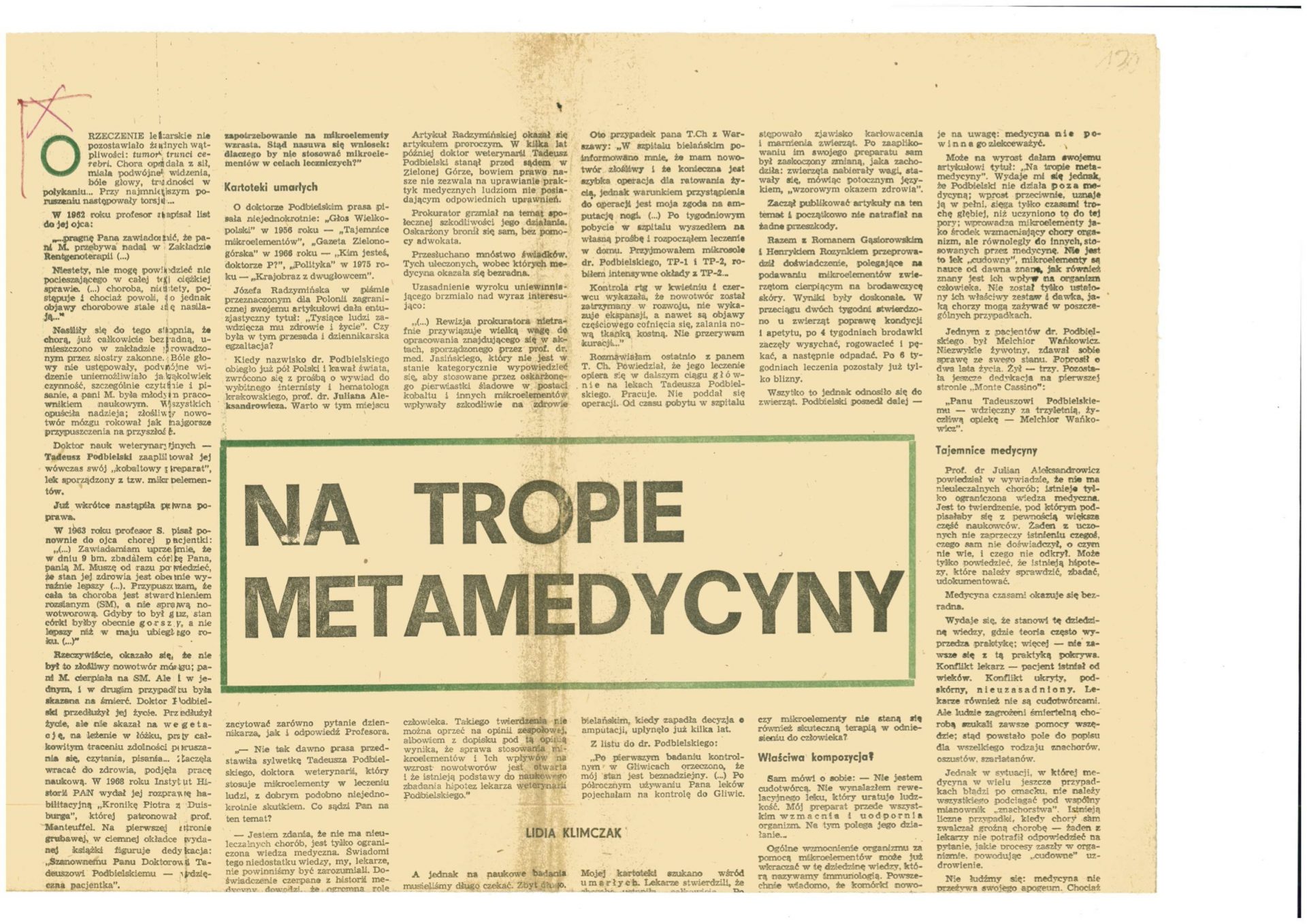
On the trail of metamedicine

The medical report left no doubt: tumor trunci cerebri. The patient was sagging, had double vision, headaches, difficulty swallowing... The slightest movement was followed by torpor....

In 1962, the professor wrote a letter to her father:
"... I would like to inform you that Ms. M. is still in the X-ray Department (...).
Unfortunately, I can't say anything comforting about the whole ordeal (...) the disease, unfortunately, is progressing, and although slowly, the disease symptoms are steadily increasing..."

They intensified to such an extent that the patient, already completely helpless, was placed in an institution run by nuns. The headaches continued unabated, double vision made any activity impossible, especially reading and writing, and Mrs. M. was a young researcher. Hope had left everyone; the malignant brain tumor portended the worst possible future.
Doctor of veterinary sciences - Tadeusz Podbielski then applied to her his "cobalt preparation," a drug made from so-called micronutrients.
Soon enough, there was a slight improvement

In 1963, Professor S. wrote again to the father of the sick patient: "(,,,) I inform you that on 9 bm. I examined your daughter, Mrs. M. I must say at once that her condition is now clearly better (...). I suppose that the whole disease, is multiple sclerosis (MS), and not a tumor case. If it were a tumor, my daughter's condition would be worse now, not better than it was last May (...)"

Indeed, it turned out that it was not a malignant brain tumor; Mrs. M. suffered from MS. But in both cases she was doomed to die. Dr. Podbielski prolonged her life. He prolonged her life, but did not condemn her to vegetation, to lying in bed, with complete loss of the ability to move, read, write...She began to recover, took up scientific work. In 1968, the Institute of History of the Polish Academy of Sciences published her habilitation dissertation, "The Chronicle of Peter of Duisburg," sponsored by Professor Manteuffel. On the first page of the thick, dark cover of the published book is a dedication: "To the Honorable Doctor Tadeusz Podbielski - a grateful patient."

The first medical diagnosis turned out to be wrong, the second was not. However, the diagnosis in this case is not the most important thing; both the malignant brain tumor and multiple sclerosis do not promise recovery. But it must have been puzzling by then that Dr. Podbielski's "miracle drug" caused - no, not a complete healing - that was impossible! - but such an intense strengthening of the organism that the devastated and initially helpless woman proved capable of writing a difficult habilitation thesis, and spent the gifted years of her life actively, physically and mentally fully fit.

Dr. Podbielski's preparation is based mainly on so-called micronutrients. In connection with an interview given by Dr. Podbielski to a Soviet journalist, Prof. J. Vienchikov stated in the pages of "Izvestia": "For the preservation of the normal functioning of the body, a small amount of micronutrients is usually needed, but with illnesses the need for micronutrients increases. Hence the conclusion: why not use micronutrients for medicinal purposes?"

Papers of the dead

The press wrote about Dr. Podbielski more than once : "Głos Wielkopolski" in 1966 - "Who are you, Dr. P?" , "Polityka" in 1975 - "Landscape with a two-headed man". Józefa Radzymińska, in a magazine intended for the foreign Polish community, gave her article an enthusiastic title: "Thousands of people owe him their health and lives." Was there exaggeration and journalistic exaltation in this?
When Dr. Podbielski's name had already circulated half of Poland and a chunk of the world, a request for an interview was made to a prominent Krakow internist and hematologist, Prof. Julian Aleksandrowicz, MD. It is worth quoting at this point both the journalist's question and the Professor's answer.

" - Not long ago, the press presented the profile of Tadeusz Podbielski, a veterinary doctor who uses micronutrients to treat people, with reportedly good results. What do you think about this subject?

- I am of the opinion that there are no incurable diseases, there is only limited medical knowledge. Aware of this paucity of knowledge, we doctors should not be conceited. Experience drawn from the history of medicine proves that a huge role is played not only by scientific verification, but also by empirical knowledge

Józefa Radzymińska:
- Dr. Podbielski shows me prospectuses coming from Uruguay. A certain pharmacist, named Federico Diaz, is active there. He is the one who crafted the drug, which includes, among other things, precisely cobalt. The drug is recommended in cases of malignant tumors, general weakness, kidney and digestive tract diseases. The doctor is pleased that a distant colleague of his has come to similar conclusions, although he certainly can't yet boast thousands of such radical, remarkable healings as our Polish doctor. The Uruguayan was in trouble with the authorities, who banned him from practicing and treating, as he was only a pharmacist, not a medical doctor, so he created the "Fundation Federico Diaz"; in this way he did not renounce helping the suffering. The authorities capitulated, as sometimes a paragraph must fall silent before a life, especially a saved one..."

Radzymińska's article turned out to be a prophetic one. A few years later, veterinarian Tadeusz Podbielski stood trial in Zielona Gora, because our law does not allow people without the proper credentials to practice medicine. The prosecutor thundered about the social harmfulness of his actions. The defendant defended himself, without the help of a lawyer.

Lots of witnesses were interviewed. Those cured, against whom medicine proved helpless.
The justification for the acquittal sounded over the top:
"(...) The prosecutor's review incorrectly attaches great importance to the study on file, drawn up by Prof. Dr. Med. Jasinski, who is unable to categorically pronounce that the trace elements used by the accused in the form of cobalt and other trace elements have a harmful effect on human health. Such a statement cannot be based on a team opinion, for it is clear from the annotation under this opinion that the issue of the use of trace elements and their effects on tumor growth is open and that there are grounds for a scientific examination of veterinarian Podbielski's hypotheses."

And one we had to wait a long time for a scientific study. Too long. Medicine has resisted and it is not clear why?

A peculiar experiment was conducted at a provincial hospital several years ago. People doomed to imminent death, in the last stage of lung cancer, were divided into two groups - some were treated "traditionally," while the others were given Podbielski's preparation. The results of the experiment, although conducted on a small scale, proved encouraging. The patients who took the drug made from micronutrients showed, as the medical statement put it, "greater comfort in survival and death itself." Also interesting is the last statement, regarding the experiment : "The observation time, which is too short, does not allow conclusions on survival."
So the drug has some effective action, even if it consists, only in alleviating the disease process. Does it also have other effects?

Here is the case of Mr. T. Ch. from Warsaw: "In the Bielany hospital ;I was informed that I have a malignant tumor and that a quick operation is necessary to save my life, but the condition for proceeding with the operation is my consent to amputate my leg. (...) After a week's stay in the hospital, I left at my own request and began treatment at home. I took Dr. Podbielski's microsols, TP-1 and TP-2, made intensive compresses with TP-2....

A check of the x-rays in April and June showed that the cancer has been stopped in its growth, does not show expansion, and there are even signs of partial retreatment, flooding with new bone tissue. I am not stopping the treatment..."

I recently spoke with Mr. T. Ch. He said that his treatment is still mainly based on Tadeusz Podbielski's drugs. He is working. He has not undergone surgery. It has been several years since his stay in Bielany Hospital, when the decision was made to amputate.

From a letter to Dr. Podbielski:
"After the first follow-up examination in Gliwice, it was ruled that my condition was hopeless. (...) After using the Lord's medication for six months, I went to Gliwice for a check-up. My file was searched for among the dead. The doctors found that the disease had completely resolved. After recovering, I took up professional work . I have been working for seven years now...J.K. Swiebodzin".
Was there interest in the "miraculous" healing of the patient in Gliwice? Yes! But this interest passed quickly. It's hard to figure out why. Maybe the diagnosis was wrong and in this situation the case was considered too trivial to bother with the Podbielski preparation?
Paradoxical, after all, even in the justification of the court's judgment there was a passage stating the grounds for a scientific examination of the veterinarian's hypotheses.

It started with animals

Actually, everything started with animals. Practicing for years, Podbielski observed that there were very significant relationships between the saturation of the land in so-called trace elements and cattle breeding. Where the land was "barren," i.e., poor in trace elements, the phenomenon of dwarfing and languishing of animals was common. After applying his preparation to them, he himself was surprised by the change that occurred: the animals gained weight and became, in colloquial terms, "exemplary specimens of health."

He began publishing articles on the subject and initially hit no obstacles.
Together with Roman Gąsiorowski and Henryk Rozynek, he conducted an experiment involving the administration of micronutrients to animals suffering from skin papillomatosis. The results were excellent. Within two weeks, the animals showed an improvement in condition and appetite; after 4 weeks, the warts began to dry out, keratinize and crack, and then fall off. After 6 weeks of treatment, only scars remained.
However, all this referred to animals. Podbielski went further - won't micronutrients also become an effective therapy for humans?

The right composition?

He says of himself: -I am not a miracle worker. I have not invented a sensational drug that will save humanity. My preparation primarily strengthens and immunizes the body. This is what it works on...

General strengthening of the body with micronutrients may already be entering that field of knowledge we call immunology. It is well known that cancer cells are recognized by others as foreign; the same is true of transplants. A peculiar thing: A transplant is sometimes rejected, i.e. the immune response is strong enough not to accept the foreign cell. In the case of cancer, this response is very weak, insufficient to reject the tumor. Thus, the efforts of researchers and scientists go in the direction of such an enhancement ( in the case of cancer) of the immune response that it rejects it, just as it rejects transplanted tissues or organs.

Of course, the matter is very complicated: skillful control of immune processes involves either strengthening or weakening the immune response. But who knows, maybe micronutrients hold secrets, not yet fully recognized by science and medicine? The case of Mr. T. Ch. I mentioned seems very characteristic, such cases Dr. Podbielski is said to have many. And even if this one was the first and the last, it still deserves attention: medicine should not ignore it.

Perhaps I gave my article an exaggerated title: "On the track of metamedicine." However, it seems to me that Podbielski does not work outside medicine; on the contrary, he fully recognizes it, only sometimes reaching a little deeper than has been done so far; he introduces micronutrients as a means of strengthening the sick body, but parallel to others used by medicine. It is not a "miracle" drug; micronutrients have long been known to science, as well as their effects on the human body. Only their proper set and the dose that patients can take in individual cases has not been established.
One of Dr. Podbielski's patients was Melchior Wańkowicz. Extremely lively, he was aware of his condition. He asked for two years to live. He lived - three. The dedication on the first page of "Monte Casino" remains:
"To Mr. Tadeusz Podbielski - grateful for three years of kind care - Melchior Wańkowicz".

Secrets of medicine

Prof. Dr. Julian Alexandrovich said in an interview that there are no incurable diseases; there is only limited medical knowledge. This is an affirmation that most scientists would certainly subscribe to. No scientist will deny the existence of something that he himself has not experienced, does not know about, and has not discovered. He can only say that there are hypotheses that need to be tested, investigated, documented.

Medicine sometimes proves helpless.

It seems to constitute that area of knowledge where theory often precedes practice; more - it does not always coincide with that practice. Doctor-patient conflict has existed for centuries. A hidden, subcutaneous, unjustified conflict. Doctors are not miracle workers either. But people threatened with a fatal disease have always looked for help everywhere; hence there has been a field for all kinds of quacks., con artists, charlatans.

However, with medicine still wandering in the dark in many cases, everything should not be pulled under the common denominator of "quackery." There are numerous cases where the patient himself fought off a dangerous disease - none of the doctors could answer the question of what processes took place in the body, causing the "miraculous" healing.

Let's not delude ourselves; medicine is not experiencing its apogee. Although it has moved forward and freed mankind from many diseases, it is far from the last word. In this situation, everything that raises doubts or, on the contrary, spells sensationalism, often unfounded, requires attention and detailed examination.

I was provoked to write this article by pure coincidence. One of my friends suffers from a serious condition: carcinoma recti. A decision was made at the hospital - surgery. He did not agree. He left the hospital on his own request. For several weeks he has been under the care of Tadeusz Podbielski. The agonizing symptoms of the disease have ceased. He has gained weight. He authorized me to describe the history of his illness.

Since this is a case of several weeks, I do not undertake to make any conclusions. Podbielski himself says he has had several such accidents and the treatment ended successfully.

So - hope?

Lidia Klimczak

podbielski-mikroelementy-tp2-artykuly-historia

Tainted by scarcity, 1974.

12 April 2021 12:52

POLICY No. 30
27-07-1974

Alexander Zaczynski
Zakopane

CONTAMINATED BY DEFICIENCY

I read R. Kowalewski's article (POLITYKA 25) greedily. The issue of "deficiency contamination," that is, deficiencies in the soil, in water, in plants of the so-called micronutrients needed for human and animal life, has been known to me for several years, i.e. since I met Dr. Tadeusz Podbielski, a veterinarian in Miedzyrzecz (Zielona Gora Province). He was the one who noticed that in certain villages in the Międzyrzecz district people were unhealthy, weak, sluggish, cows did not give milk, and cattle in general weighed half of what they should. He gave the feed to be tested and found that it lacked cobalt and copper. He prepared the appropriate liquid mixtures, which were rained on people and cattle. The effects were downright miraculous: people recovered, cows began to give milk, animals gained weight. The preparation was administered to cancer patients, who were discharged from the hospital as incurable, and in a number of cases there was improvement or complete recovery. After enthusiastic reports about the miracle-worker from Miedzyrzecz appeared in the press, the doctor's house began to be invaded from all over Poland by hundreds of people a day, begging for healing. The case was taken up by the authorities, and the prosecutor implemented an investigation against the doctor, but it was discontinued for lack of features of a crime. The micronutrients given to the people turned out to be harmless to health.

Dr. Podbielski did not want to become a "miracle worker" (he was still a veterinary surgeon at the time - he got his doctorate just before retirement) and wanted to pass on his discovery to science. Unfortunately, all letters to oncology institutes, specialists and scientists went unheeded. Only Prof. Julian Aleksandrowicz, to whom I reported his discoveries, took an interest in the matter.

Thus, an unknown and humble veterinarian from a small town can have, after the article published in our pages, full satisfaction that his discovery was shown not only to science, but also to the general public.

ALEXANDER ZACZYNSKI
Zakopane

The Mystery of Dr. P., 1983.

12 April 2021 12:52

Gorzow Land March 18, 1983.
"The Mystery of Dr. P."

Sophia and Tadeusz Podbielski of Miedzyrzecz are already a great and beautiful legend of a noble, wise and hardworking life. A dozen days ago they celebrated 50 years of marriage. These days Dr. Tadeusz Podbielski, who is famous in the province and the country, is celebrating his 80th birthday. Both are tireless social activists. They actively joined the work of the Patriotic National Revival Movement. The inventor of sensational peculiarities - micronutrients under the name of TP - has earned the gratitude of countless numbers of those he has helped through illness or saved lives. Both combine kindness of heart and nobility of reason. Kindness towards people and a wise attitude towards public affairs. To the anniversary wishes we add ours: many, many years of health.

A passion for living for others, 1983.

12 April 2021 12:52

The Common Word
Journal of the PAX Association
W-wa 11-12-13 March 1983.

"... I cried with happiness and - I knew that it was caused by the Lord's preparation...".

A passion for living for others

A Warsaw rental house in Powisle district, with a typical courtyard-well. In this courtyard winds a queue of people of all ages and genders. The queue laboriously climbs to the second floor of the tenement and here it joins with another one that reaches up to the top of the third or perhaps fourth floor. Both of these streams of people head for the apartment, on the door of which hangs a modest business card: Zofia and Tadeusz Podbielski.

Who is it? Tadeusz Podbielski?

- Dr. Z. K. doctor from outside Warsaw - Podbielski? Right away, for once, I heard something. No, I do not associate this name with anything.

- Dr. K. K. a doctor from Warsaw. - That's the charlatan what le or mallow extracts... What? You say it's not that one? But surely, surely mallow extracts.

- B. D, M.D., pharmacist - That name makes me think of something. I already know - micronutrients?

HUNDREDS of people who stand patiently in line know exactly what they came here for. They want to get two not big bottles with a mysterious inscription "TP-1" and "TP 2" Inside is a pink-colored liquid is the preparation TP 1, and with a brown-green color this color has TP 2. Is it a miracle drug, an elixir of life?

Ladies and gentlemen, imagine- a royal dinner, but without salt - a good one will not be - Dr. Podbielski's voice is strong and lively. What I am giving you is micro-salt. Similar to our table salt, this is the salt for the royal dinner. The idea is to improve the treatment...

The chat begins, for the next group of interested parties. In a small room an incredible squeeze, all the seats and standing places are occupied.

"Please listen urgently," repeats Dr. Podbielski because I do not have the opportunity to talk to each of you..."

Dr. Podbielski patiently explains how to use TP 1, in what amount and in what way. His language is colorful and juicy.

"...What does TP 1 do? Improves appetite where there is none. It regulates digestion and bowel movements. And this enemy needs to be swept out of our body every day. Through the blood, it improves oxidation. Lack of oxygen - it and in the stove do not want to burn, legs like cotton wool, lungs function badly. Oxygen, like a sword, beats germs.
However, if someone smokes cigarettes - there health will not be, there is not. There I don't give medicine, because what's the point. In cigarettes we have only 57 carcinogens, enough?"

Dr. Podbielski's voice is rising to a shout. Acrimonious is the anti-smoking activist. He gives examples of nicotine poisoning "cultured house - I hear the story - masters, doctors, but chaps rotten, scrolled brains. Attention - it promises to be fertile - but for cancers, for heart attacks. Hard to talk, because hardly anyone understands. How many in the offices of these smokers. Is it a culture? To us it would be necessary to invite Khomeini to do some order.

Let's enter the hospital. And that's where it gets smoky too, the doctors, the nurses. Faces even nice, but from the mouth yawns those 57 carcinogens. Remember smokers, from the first cigarette you lay the foundation for cancer."

I LOOK discreetly at the assembled people. I see hands that put down the cigarette they already hold, seriousness is painted on faces. No one is laughing, although the way they speak may seem ridiculous. If we had such activists, I think to myself, the tobacco monopoly would go with the bags in no time. Dr. Podbielski is suggestive, believes wholeheartedly in what he says, and will make others believe in his words.

The chat has been going on for several minutes. We are back to TP 1 and TP 2. There are various ways to apply the preparations - drinking, poultices, rinses, inhalations, lubrication. But the use of microsols, or micronutrients, is only half of Dr. Podbielski's prescription. The other half is diet, according to which one should avoid fried and smoked things ("tastier, but shorter you will ingest these delicacies"), enrich the daily menu with vitamins ("as much vitamin C as possible; but not in -pills, but in nature"), drink herbs ("a protective coat, a shield for our body"). All in all, the prescription serves to strengthen the defensive forces, for it is necessary to "capture this beast, chain it ! da funnel let it bark lightly already".

Rich and vivid is the language of Dr. Podbielski, He conjures before the listeners images as if from a battlefield, in which he goes for the health and well-being of the patient. The main weapons are TP 1 and TP 2 preparations. But at the same time none of the doctor's patients are allowed to escape from official medicine, abandon prescribed treatment, forgo surgery. Dok tor Podbielski does not claim the right to treat the drops are to be that pinch of salt to the royal dinner.

Environmental chain

MICROELEMENTS, trace amounts of elements such as iron, copper, zinc, magnesium, cobalt. As it turns out, these elements are very necessary for a number of processes in living organisms. Today, the value of micronutrients is no secret to anyone. They enrich, they are an ingredient in vitamin preparations, they are an ingredient in all kinds of nutrients, such as the fashionable BIOVITAL or BUERLECITINA (to buy in Pewex), VITARAL, FALVIT and to buy in pharmacies. So what's so great about Dr. Podbielski's drops? What sets them apart from hundreds of similar preparations? Before I try to answer these questions, let's see how it all started

And it started a good few decades ago, when no one had yet dreamed of micronutrients. District veterinarian from Miedzyrzecz Dr. Tadeusz Podbielski associated the poor health of cattle with poor soil, which lacked... essential mineral salts, micronutrients.
It was 1948, and everything was hard to come by, but not for Dr. Podbielski, who "howled" the necessary elements, even cobalt. Added to the feed in the form of a salt solution (which Mr. and Mrs. Podbielski first tried on themselves at the physiological level), it had a positive effect. The health of the animals improved before their eyes - the cows began to eat willingly, gained weight and began to give as much milk as decent cows should give.

The FIRST experiments also brought the first eyeful of publicity. After cows, it was the turn of pigs, followed by dogs. Finally, it was the turn of humans. Dr. Podbielski was already convinced that micronutrients "were the way to go," that he was taking the right path. Those first patients were a "run-down" rural family. Because where the animals failed, the people also became unwell.
- Dr. Podbielski," says Associate Professor Stanislaw Grabiec, head of the Biochemistry and Biophysics Laboratory of the Department of Parasitology of the Polish Academy of Sciences, "approached the matter in a scientific manner, as required by systematic ecological methods. Soil - soil products animals - people: He observed, perceived and drew conclusions.
Few people have such a gift - of constantly thinking, of constantly ' asking themselves "why?", of constantly searching for the answer to that question.

And maybe that's why Doc. Grabiec considers Dr. Podbielski as one of those who are like milestones in science.... And he has known Dr. Podbielski for more than a dozen years, has worked with him and knows what he is talking about.
The first official presentation also took place at this time. The doctor, in a paper entitled. "Beneficial Results of Micronutrients in Animals and Humans," he naturally presented the results of his work, those results of which he was certain. It was also an attempt to enter official medicine.

This entrance Dr. Podbielski is still paving his way to this day. But when asked about recognition from official medicine, he waves his hand dismissively - it's difficult in our country to get "scientific support." There has been no ba ding of the drug in oncology clinics, although such studies were announced. Dr. Podbielski has in his archives letters from the Institute of Oncology in Gliwice, from the Department of Endocrinology of the Medical University of Lodz, and rich correspondence with the Institute of Oncology in Warsaw. The content of the letters is similar to the one he received from the Institute of Oncology, in which Prof. K. notifies him that "at the moment, due to the preoccupation with work on the government program 'fighting cancer', we do not have the possibility to conduct research in tissue culture and on animals." The letter is accompanied by a memo from three doctors at the institute, who write: "After reviewing the materials provided on the effects of micronutrients on oncological diseases, we conclude that nothing can be said on the basis of these data about the effects of these substances on the animal and human body." And that "clinical observation of patients, in whom cobalt salts were used at one time, did not confirm their therapeutic study in tumors," and that "the preparations can be of interest to laboratories performing animal ba ditions, tissue cultures and other pharmacological studies."

That was in 1976, Prof. K. in an interview in February 1983, does not change his mind. "May write tells me that-no therapeutic effect found," he says. Of Dr. Podbielski, he has a good opinion.

Thus, neither yes nor no. The sentences are balanced, but not just because courtesy demands it. It is difficult to definitively deny the documentation presented by Dr. Podbielski, it is difficult to unequivocally negate the testimonies of people who, after treatment with "TP 1″ and "TP 2″, feel great, perfectly tolerate such dangerous therapeutic methods as radiation, it is difficult to resist thousands of letters expressing gratitude. Official medicine does not want to admit "TP 1″ and "TP 2″. Prof. Maria D., a neuropathologist, said: "I know that my patients who take Podbielski micronutrients feel great. But I officially can't without research after know anything concrete."

But it's not true that the studies aren't there. Are there? They are carried out by Dr. Podbielski himself, an indefatigable spirit, a man who, at 71, could afford to submit and defend (not at all "painted") his doctoral thesis: ,;The effect of trace amounts of cobalt chloride on oxidoreductive processes in parasites on the example of the liver fluke". I learn about a study that measured the survival time of mice exposed to micro-phthalates. Those watered with cobalt chloride lived the longest (14 sec), mice in the control group without cobalt died after 3, 4 seconds. Other studies conducted by the Department of Human Physiology at the Institute of Biological Sciences at the AWF (also on mice) confirm these results. And here "mice with cobalt" lived longer in tightly closed cages than mice that were not given cobalt. So what lies in Dr. Podbielski's drops?

Biogenic stimulator

Doc Stanislaw Grabiec said:
- I met Dr. Podbielski 15 years ago at a meeting of the M. Copernicus Polish Natural History Society. He re ferred his work with enthusiasm. I must admit that I did not believe it very much. However, I got a sample and began to give it by analytical methods. And it turned out that the doctor's preparation works wonderfully as a biocatalyst, like an enzyme.

- Combustion in a living cell is controlled, - doc. Gra biec passionately explains the processes concerning the secret of life, - and enzymes are responsible for this. But enzymes are proteins, and behind tem large particles. Moreover - particles that are easily poisoned, destroyed, inactivated. Micronutrients work in a similar way, but the difference is that as small chemical particles, they penetrate more easily, and are not destroyed. This is an important detail from the point of view of physiology. If their action is similar to that of an enzyme, that is; it involves o law of oxidoreductive processes.

- Oxidoreductive processes - oxidation and reduction, One more concept to decipher. These processes determine the life of the cell, the continuous metabolism. In the so-called metabolic mill there is constantly adenosine triphosphoric acid - ATP. However, in order for this acid to be formed, oxidation and reduction processes are needed. "TP 1" intensifies these processes, using the preparation accelerates the energy-generating processes. So? So, "TP 1″ is not a drug. It is a valuable biostimulator. And just the discovery that it is a biostimulator - was a big surprise for the docent.

DOC. GRABIEC demonstrates to me the action of micronutrients using a photon emission analyzer. The screen of the apparatus shows numbers - this is the number of photons emitted during combustion The numbers increase in order to, then settle at a certain, constant level. The so-called "plateau" is formed, the processes are just maintained at a certain, constant level, the combustion is very economical and efficient. As it happens in nature, This is another value of micronutrients Podbielskie go - physiological action.

The second value - the form in which these micronutrients are given, the most physiological form, in diluted solution. Thanks to this, micronutrients almost immediately penetrate into the blood, the moment of critical concentration (not safe potential difference at the phase boundary), which we have to deal with when micronutrients are administered in solid form, such as in lozenges, is bypassed.

The third value - a set of micronutrients. "TP 1" is first of all cobalt chloride which in Podbielski's is active always, Given allegations about the optimal concentration. The concentrations are so small that even the addition of cobalt will not spoil anything. "TP 2" is much richer, it contains more elements, There is iron - necessary for electro n transport, copper - needed for proteins, zinc and magnesium - important for biosynthesis processes. The selection of micronutrients is such that their effects do not cancel each other out.

And "TP 2″ acts on a number of processes in the living organism.
- In my many conversations I have encountered the statement that micronutrients are nothing new after all, that there is no point in taking Podbielski drops if you get the same thing by swallowing vitamin mines. So I ask the docent what makes Pod Bielski's micronutrients different from the ones we have on the market.

- It is like this: as happens with great inventions after particular elements are well known, but the whole presents a completely new quality. To get a set of values of "TP 2" you need to take at least five different vitamin preparations. And the equivalent of ,,TP 1″ does not exist at all.

I am still learning that biostimulants are especially needed for decaying diseases. This is where the success of "TP 1" and "TP 2" in cancer comes from. That they are especially valuable for old people as so-called "excitons" a under carrying life energy. That accusations like "micronutrients work for everything" are unfounded, because they are not medicines and are not about curing but about boosting immunity.

He expresses enthusiasm about Dr. Podbielski, with whom he has worked and collaborated for so many years. He appreciates his analytical outlook, his insightful and critical in premise research programs creative passion. " I have witnessed many conversations - he is a very thoughtful and wise man. In any work we did, his participation was always greater. Even the so-called black work he did willingly and with youthful energy. Podbielski is treated by doctors with a bit of irony - well, not bad, but maybe he took it from the Germans? Podbielski came to everything by his own work. He is a beautiful example of a free scientist who has his own idea and pursues it independently.

When on, the market?

The ONLY manufacturer of "TP 1" and "TP 2" so far is Dr. Podbielski. A few years ago he received a patent for his preparations. But this does not at all mean that he guards the secrets of the workshop jealously. He has been submitting applications for development and dissemination since the mid-1960s. The results are not forthcoming.

What are the chances of producing "TP 1" and "TP 2" on a wider scale? In the pharmacy department, I learn that in order for "something" to happen to a drug, first of all, an attestation is needed about the so-called expediency of production. Such an attestation is issued by the Medicines Commission under the Ministry of Health, the process is long and must be expertly documented. I also learn that Dr. Podbielski has little chance. of such expediency being granted, because after all... micronutrients are known and used. Unless..., the effect of "his" micronutrients, would be absolutely unique.

At the Institute of Medicines they tell me that first there must be a positive opinion of the Medicines Commission, and only then does the institute to become a drug for testing. Well, and the most important thing - first there must be a manufacturer, a factory that produces the drug. It is the factory that receives the approval, never a private person. And research without the pharmaceutical industry cannot be undertaken, because it is the industry that evaluates a number of parameters.

The procedure for introducing a new drug, moreover, is in general an incredibly arduous and lengthy procedure. It requires experiments on animals and then clinical trials on humans. These are comparative studies, during which the proposed drug is pitted against the best one used so far. It is a machine so complicated that a private person has no chance here. So first, second and third you need a manufacturer.

Dr. Tadeusz Podbielski is reaching his eighties. "TP 1" and "TP 2" officially do not exist. Although hundreds of people crowd into the Warsaw apartment, although thousands come to Miedzyrzecz Although in the home archives of Mr. and Mrs. Podbielski one can find dozens of thank you dedications, including from passed people of science, who do not mind that "TP 1" and "TP 2" brought Dr. Podbielski to the court bench three times.

Podbielski's micronutrients are known in the wits of Polish hospitals. Sick people drink them, and doctors don't mind. Their fame has long since crossed the borders of the country. Podbielski was interested in the USSR, where he was invited several times, in America, West Germany. And who knows if the proverb will not be valid again; that no one is a prophet in his own country.

But for now... For now, Dr. Podbielski and his wife Sophia are preparing, with their own hands, their specifics. Although it's getting harder and harder for them to get raw materials, it's getting harder and harder to get bottles. But can the trust of those who wait be reposed? Those who see a shadow of hope in magic drops? So they don't fail, and later receive letters like this one from Sophia N:

- "I learned that there is no sign of malignant cancer. There are minimal lesions that can be cured. I cried with happiness, and I knew that the Lord's preparation had caused this..."

MARIA ZERA
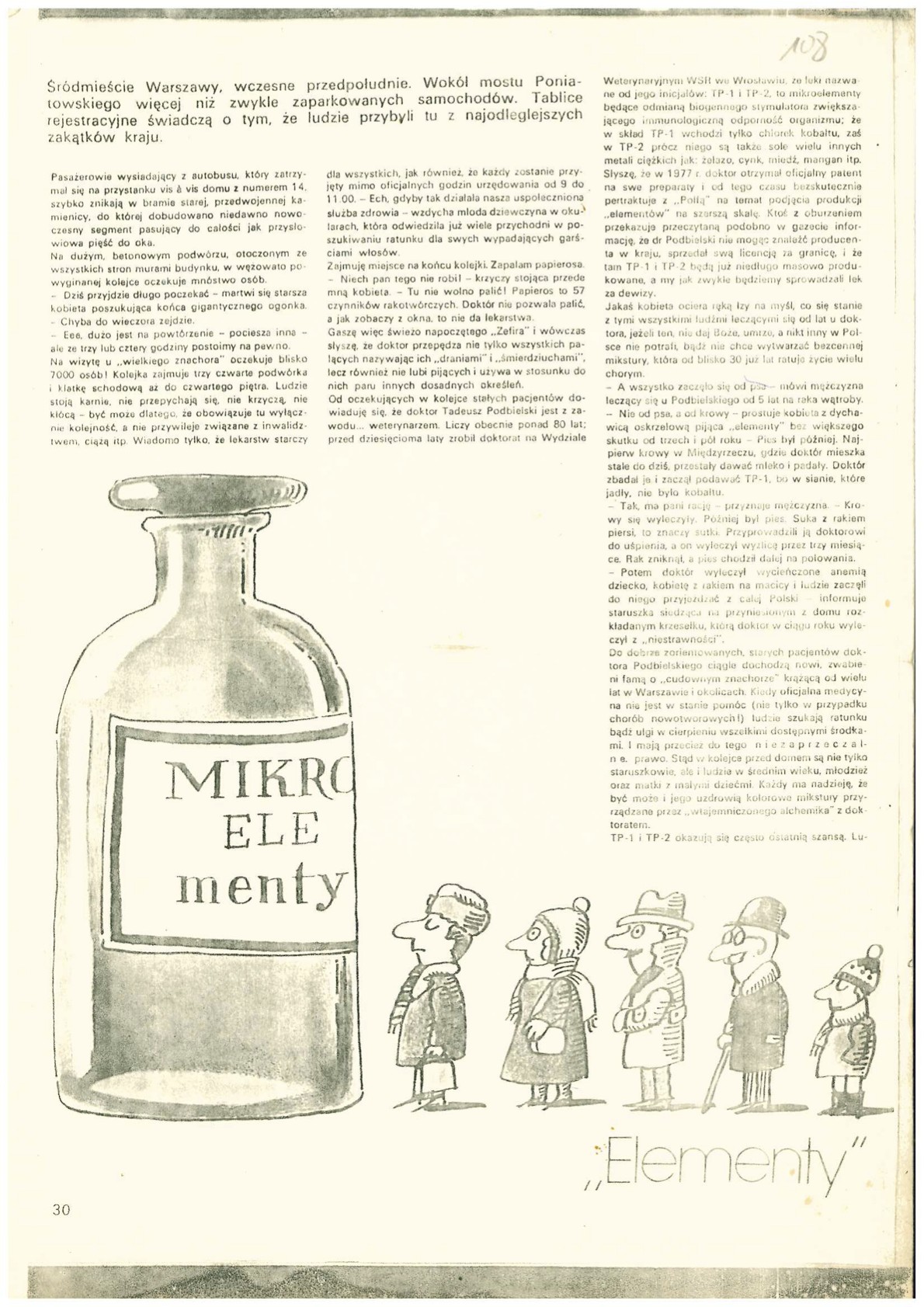
en_USEN